
In 2023, more than 900,000 people died from cardiovascular disease in the U.S. That's the equivalent of one in every three deaths, according to the Centers for Disease Control and Prevention (CDC). The CDC reports that heart disease is the number one cause of death for both men and women in the United States.
February is American Heart Health Month, and it is a great opportunity to raise awareness of cardiovascular health and spotlight interventions occurring at the individual and community levels.
Our partners are doing incredible things right here at home to advance life-changing discoveries to identify risks, prevention, and treatment for cardiovascular health.
Beginning in the 1950s, Children’s Health began to make significant advances in the care of heart disorders and open-heart surgery.
Today, they continue to lead the nation in cardiovascular care.
The Heart Center at Children’s Health:
- “Perform[s] more than 600 cardiac surgeries each year, from minimally invasive approaches to complex heart surgeries—with one of the highest survival rates in the nation”.
- “[Is] one of the largest pediatric heart transplant programs in the country, performing about 25 to 30 transplants each year”.
Children’s Health consistently ranks as one of the top children’s hospitals for pediatric cardiology and cardiothoracic surgery in the country.
Parkland Health performed the first open-heart surgery in Dallas in 1956 and continues to be on the leading edge of heart health today.
In 2025, Parkland Health received the American Heart Association’s Commitment to Quality award for achieving high performance across three or more clinical areas in the Get With The Guidelines® program.
“This recognition is a testament to our team’s unwavering commitment to caring for the whole person, not just addressing a medical condition".
-Michael Lane, MD, Senior Vice President and Chief Quality & Safety Officer at Parkland
Recently, a Parkland physician shared this lifesaving message during American Heart Month (linked).
The Department of Internal Medicine at UT Southwestern has been working on the Dallas Hearts and Minds Study since 2000. The study began its third phase in 2024, with an expanded focus on brain health and 1,500 participants.
“As the only single-center heart study of its size and multi-ethnic composition, the Dallas Hearts and Minds Study has been groundbreaking for UT Southwestern, with researchers worldwide using its data to advance understanding of cardiovascular and brain health”.
-UT Southwestern Dallas Hearts and Minds Study
You can learn more about this groundbreaking research study by visiting the website.
As we celebrate the extraordinary medical leadership shaping cardiovascular care in our community, it is equally important to consider the integral role that our environments play in our health and well-being, and specifically, our cardiovascular health.
Did you know that there is an inherent connection between trees, green space, and cardiovascular health?
Read on to learn more about how we can create greener and heart-healthy communities.
1. There's a lot to  about trees.
 about trees.
8,000 trees were planted in a neighborhood in Louisville, KY, as part of the Green Heart Louisville Project. To support what many know anecdotally to be true about the positive association between health and nature, this project has generated strong clinical evidence to support the need for more trees, particularly in areas with poorer health outcomes.
The trees went in the ground in 2020, and researchers were astounded to find, as early as 2024, that neighborhood residents who lived the closest to the trees planted had experienced a significant decrease in hsCRP, an inflammation marker in the blood. Lower levels of inflammation are associated with reduced risk of heart disease, so this is a huge win!
This effort has taken place through a collaboration between the University of Louisville and Hyphae Design Laboratory, among others.
Did You Know?
We’re proud to count Hyphae Design Laboratory as a partner on the SWMD Transformation Project. Hyphae is a mission-driven engineering firm leading the project’s evidence-based design strategy. Their approach of measuring, modeling, and modifying ensures that design interventions are pre-tested, data-driven, and grounded in positive ecological and human health outcomes. Read more about our collaboration with Hyphae and other partners by visiting our Data and Design webpage
When cross-disciplinary experts come together, we can make great strides in creating healthier communities and healthier cities! We’re excited for the potential to create similar positive change right here at home in Dallas’s Medical District.
2. In our busy lives, access to nature is everything, and we can make a big difference by bringing trees and green space to areas that need it most.
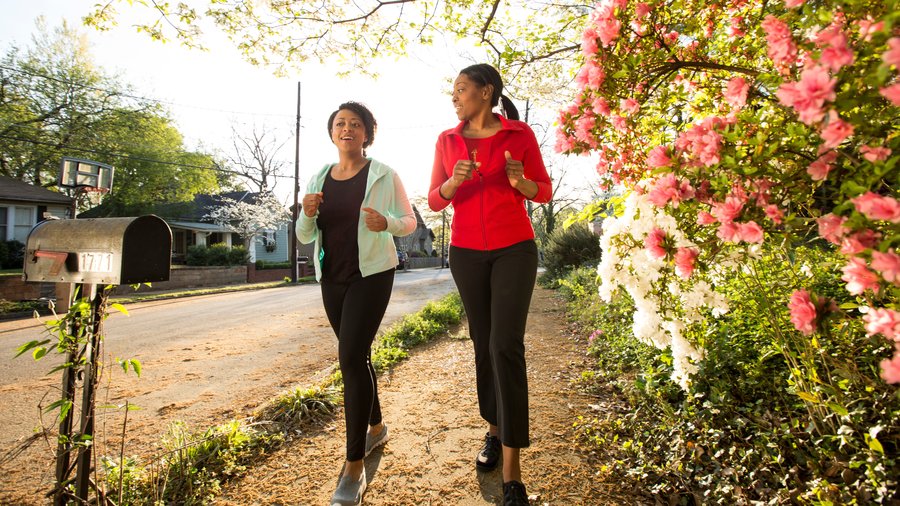
Access to a nature trail, park, or other green space can act as a protector against developing diseases such as heart disease.
A 2024 study published in the academic journal Circulation found that living in an urban environment with access to nature can decrease your chances of developing coronary artery calcification (CAC), an early sign of heart disease, and a risk of a heart attack. This was especially true for Black participants and those living in neighborhoods with lower socioeconomic status.
According to Dr. Lifang Hou, MD, PhD, chief of Cancer Epidemiology and Prevention at Northwestern University Feinberg School of Medicine:
Physiologically, exposure to green spaces has the potential to:
- Boost your immune system
- Reduce chronic inflammation
- Slow down the biological aging process
Practically, green spaces offer:
- More opportunities for physical activity
- Spaces for social interaction
- Natural stress relief
All of these benefits play a part in improved cardiovascular health.
“The connection between urban tree canopy and heart health is undeniable. Expanding tree cover in urban areas helps mitigate extreme heat, improves air quality, and fosters community spaces that encourage physical activity, all of which contribute to better cardiovascular health outcomes.”
-Pamela Gamon Johnson, Senior Vice President, American Heart Association
Okay, now that we know the benefits, let’s get specific about how to make them happen.
Different amounts of time spent in nature offer different benefits.
- 10 minute-exposure to nature stimulates heart rate variability and parasympathetic activity (Brown, Barton, & Gladwell, 2013).
- 30 minutes can improve heart health, circulation, and lower cholesterol (National Park Service).
- 60 minute-exposure to nature can restore heart rate and blood pressure and lower cortisol levels (Determan, et. al, 2019).
Grab a friend, neighbor, your sneakers, earbuds, or your favorite book, and head to your favorite green space, and, as my Kinesiology Professor in college used to say, “get those happy hearts pumping!”.
3. For Improved Heart Health, Think of Trees 1st! 🏅
We’ve covered that green spaces are good for our general health and wellbeing, and specifically, our heart health. But, did you know that, if there were a competition of green infrastructure types, trees would take home the gold medal for the greatest impact on heart health?
According to a study just published in Environmental Epidemiology this month, “living in urban areas with a higher percentage of visible trees was associated with a 4% decrease in cardiovascular disease (CVD), the study found. But areas with a higher percentage of grass were associated with a 6% increase in CVD, and areas with other types of vegetation, such as bushes or shrubs, were linked with a 3% increase in CVD”.
This astounding finding reveals that, while trees were associated with a decreased risk of cardiovascular disease, trees and shrubs were actually linked to an increased risk of cardiovascular disease. According to UC Davis Health, the researchers presumed that this linkage could be due to factors such as “[the] use of pesticides, air-quality impacts from mowing, lower cooling capacity than trees, and lower capacity to filter noise and air pollution”.
This finding reminds us of how deeply embedded individual health outcomes can be in our environment. This article presents a novel angle to approach cardiovascular health, encouraging decision-makers to approach heart disease from a preventative, community-level, urban planning perspective, rather than interventions focused solely on the individual.
“Our findings suggest public health interventions should prioritize the preservation and planting of tree canopies in neighborhoods.”
- Peter James, Associate Professor, UC Davis Department of Public Health Sciences, and director of the Center for Occupational and Environmental Health
The SWMD Transformation Project aims to bring health and healing into the public realm, knitting together the Medical District through green infrastructure.
A key feature of the design will be tree groves dotted throughout the Harry Hines Corridor – the Green Spine – and in the future Green Park.
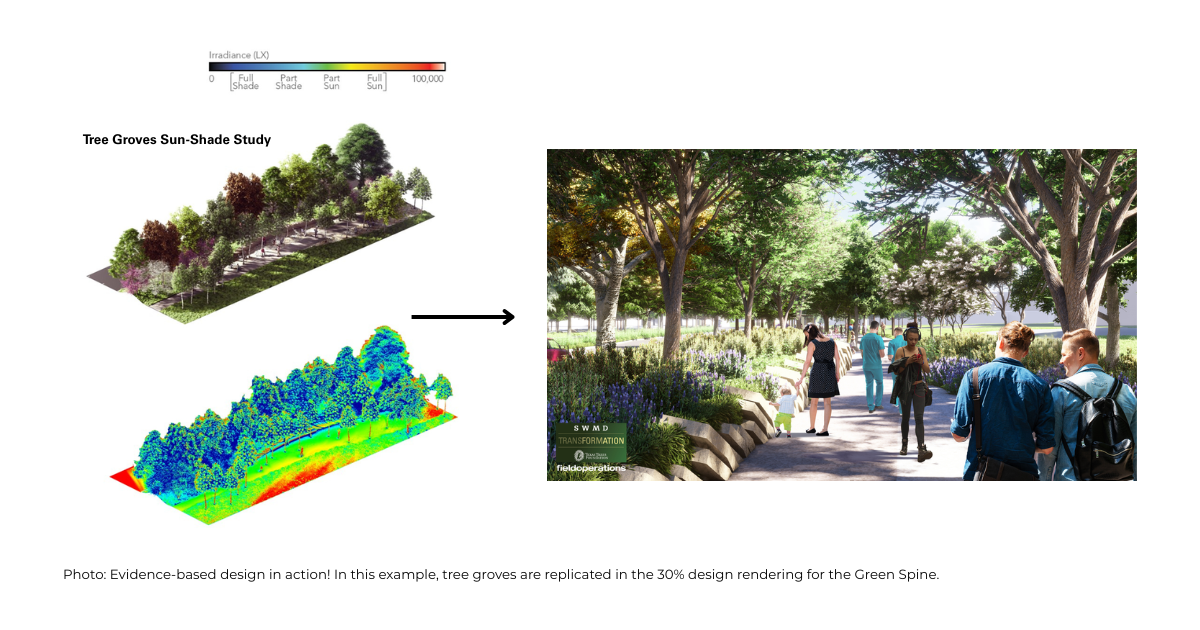
Grouped in clusters of trees of various species, sizes, and spacing, tree groves replicate the experience of walking through a natural forest, adding beauty and ecological function to landscapes. Strategically positioned, tree groves effectively cool urban environments through enhanced shade coverage. Tree groves provide resiliency in the face of environmental stressors, reducing stormwater runoff, heat stress, and improving air quality. Furthermore, tree groves support tree longevity through a shared root system.
Tree groves prioritize both tree health and the health of the people using the space.
Together, we’re transforming the outdoor environment to support what it means for a place to promote health, healing, and well-being.
Learn more by visiting our website.
Source List
- Center for Disease Control | Heart Disease Facts
- American Heart Association | American Heart Month
- Southwestern Medical District: Prehistory to the Future of Medicine
- Children's Health | Pediatric Cardiology and Cardiothoracic Surgery
- Parkland Health recognized for quality care across specialities
- UT Southwestern | The Dallas Hearts and Minds Study
- Green Heart Louisville
- American Heart Association | hsCRP Insights for Healthcare Professionals
- University of Louisville
- Hyphae Design Laboratory
- Texas Trees Foundation: SWMD Transformation Project | Data + Design
- The Healing Power of Trees | The Nature Conservancy
- Green Heart Lousiville
- Circulation | Associations of Urban Blue and Green Spaces With Coronary Artery Calcification in Black Individuals and Disadvantaged Neighborhoods
- American Forests
- Northwestern University
- Environ Sci Technol | Viewing nature scenes positively affects recovery of autonomic function following acute-mental stress.
- National Park Service
- Impact of Biophilic Learning Spaces on Student Success
- Assessing greenspace and cardiovascular disease risk through deep learning analysis of street-view imagery in the US-based nationwide Nurses’ Health Study