
People deserve to live with access to nature where they can thrive beyond the walls of their own homes. This requires the intentional integration of green with gray infrastructure where communities can create environments that support the health and wellbeing of the people who live, work and play in their regions, even when faced with unprecedented growth. When urban development happens without human health in mind, prairies and forests are lost to expanses of hard, hot concrete that create what’s known as the urban heat island effect, increasing localized temperatures by 15-20 degrees or more. The urban heat island (UHI) effect occurs when cities experience significantly higher temperatures than surrounding rural areas. Dense concentrations of buildings, roads, and dark surfaces absorb solar heat during the day and radiate it back, making urban neighborhoods warmer both day and night.
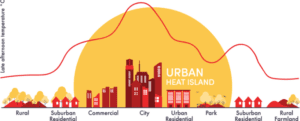
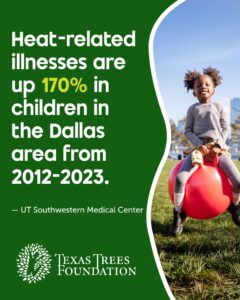
This urbanized heating effect has been shown to have damaging consequences for human health. Higher temperatures increase mortality rates, raising the risk of heat stroke while also exacerbating chronic health conditions such as cancer, diabetes, mental disorders, cardiovascular and respiratory diseases. Those most at risk are children, the elderly, and the sick with an even higher risk in disinvested and low-income neighborhoods. Communities with fewer trees show a 6% higher mortality rate than in cooler precincts. Research , while Dallas County Health and Human Services reported nearly 126 emergency room visits for heat-related causes since May 2026. Extreme heat kills more people most years than hurricanes, floods, and tornadoes combined (The Lancet).
But development need not come at the expense of health and wellbeing. With thoughtful land use planning and data, Texas’ growth and economic appetite can drive investment in green communities that are healthy for people.
TEXAS TREES RESEARCH
Approximately 35% of Dallas is covered by heat-absorbing surfaces such as roads, parking lots, and buildings, while some areas reach as high as 69% impervious cover (Texas Trees Foundation, Urban Heat Island Study, 2017, p. 5). These areas can be 10 to 15°F hotter than nearby neighborhoods with more shade (Urban Heat Island Study, 2017, p. 39). Heat also lingers longer into the evening, leaving less opportunity for a neighborhood to cool down before the next day’s onslaught of high temperatures.
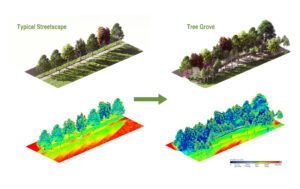
Trees are a direct, evidence-based solution to lowering urban temperatures and supporting overall human wellbeing. Trees provide shade to impervious surfaces and control micro-climates around them through a process called transpiration, which is when water evaporates through the leaves and the moisture goes into the air, creating cool oases against the brutal summer sun. Texas Trees also found that tree groves—i.e., trees planted in groups modeled after natural forests—compound these individual benefits of trees and provide one of the most effective defenses against urban heat. Compared to a row of trees, groves create more shade, cooler public spaces, and healthier growing conditions for trees themselves.
The results that can be accomplished when we invest in green infrastructure are undeniable. A healthy urban forest provides a natural solution to the risk of the urban heat island effect while also impacting other aspects of people’s lives, including mental and physical health, energy usage, feelings of safety, and even the ability to learn. We must act now to mitigate the urban heat island effect for the sake of our health, the economy and viability of our community. Texas continues to see unprecedented growth, and with growth comes new buildings, roads and parking lots. It’s imperative that we come together to balance the grey with the green to ensure Texas is a desirable place to live and work for generations to come.
When planted intentionally and maintained over time, the impact of trees is transformational.