
Earlier this summer, the North Dallas Chamber of Commerce kindly hosted the Texas Trees Foundation and our partner, the Southwestern Medical District, for a Leadership Briefing on the Southwestern Medical District Transformation Project.
Picture the setting for this event, and you’ll quickly realize how this conversation took on additional layers of meaning. In June, just as our Dallas summer began to heat up, so did a series of news stories – from shuttered downtown businesses to high-profile corporate and sports team relocations to the ongoing debate about City Hall’s future – that together portrayed the future of our city as muddled and uncertain.
We gathered for the monthly meeting of the North Dallas Chamber of Commerce – whose mission is to make Dallas a better place to live, work, raise a family and build a business – eager to hear some good news about Dallas, and to be reignited by our peers who are advancing great work across our city. This convening painted a much more positive picture of Dallas’s future than the major headlines at the time would have us believe.
We gathered for the monthly meeting of the North Dallas Chamber of Commerce – whose mission is to make Dallas a better place to live, work, raise a family and build a business – eager to hear some good news about Dallas, and to be reignited by our peers who are advancing great work across our city. This convening painted a much more positive picture of Dallas’s future than the major headlines at the time would have us believe.
The Chamber’s office sits at an especially relevant location for our conversation. 5710 Lyndon B. Johnson Freeway is directly adjacent to the Interstate 635 and Dallas North Tollway interchange. It is surrounded by a multitude of heat-absorbing land uses such as buildings, parking lots, and roadways, which, coupled with low tree canopy, exacerbate the urban heat island effect. The freeway is the only barrier between its office and the former Valley View Mall site: the proposed location for the Dallas Mavericks’ new arena and the surrounding mixed-use hub, whose vision includes public green spaces among many other amenities.
The focus of our conversation, however, was on another location nearby. If you were to hop on the tollway and travel several miles south, you would be entering the Southwestern Medical District. This neighborhood, we’d argue, is one we ought to be paying special attention to, as current and planned investments collectively strengthen the role that our Medical District plays in renowned healthcare, esteemed medical education, and innovative medical advancements in our city.
Matt Moore, Chief External Relations Officer at Children's Health, graciously welcomed the group, setting the scene of the program with an important reminder of the Southwestern Medical District's critical importance to our city: "Part of the future of Dallas is the Medical District. We don’t talk enough about the innovation, education, research, jobs, and the economic impact the Medical District has on the City of Dallas."
The numbers truly do speak for themselves: 43,000+ employees  and 4.7 million annual patient visits
  are astounding levels of impact, and as North Texas grows, the Medical District is rapidly responding to meet 21st-century demands. They’re adding new facilities, such as the $5B new pediatric campus underway and the recently opened Texas Behavioral Health Center. The UT Southwestern School of Public Health enrolled its first students a few years back, and the Center for Brain Health is advancing some of the most innovative work of its kind. And the vision for the District’s future doesn’t stop there...
"Part of the future of Dallas is the Medical District. We don’t talk enough about the innovation, education, research, jobs, and the economic impact the Medical District has on the City of Dallas."
-Matt Moore, Chief External Relations Officer, Children's Health
The Southwestern Medical District Transformation Project asserts that Dallas deserves a medical district designed for health, healing, and innovation beyond the footprint of its buildings, well into its public spaces. Through a collaborative partnership with the City of Dallas, Southwestern Medical District, and its project partners, the Texas Trees Foundation is leading a transformation that reimagines the public realm as a holistic, green campus. One that unites the community, promotes comfort and safety, and truly represents the intersection of health and nature.
The Southwestern Medical District Transformation Project asserts that Dallas deserves a medical district designed for health, healing, and innovation beyond the footprint of its buildings, well into its public spaces.
Lannie McClelen, PLA, ASLA, SWMD Transformation Project Director, opened the program with an engaging presentation that highlighted a fundamental contradiction at the heart of the Southwestern Medical District: while groundbreaking medical care, healing, and innovation take place inside its facilities, the outdoor environment often works against those same goals. She outlined how the project aims to bridge this gap through innovative improvements to the district’s public realm.
Let’s set another scene: The Medical District is nested within a complex web of urban and environmental challenges: tree canopy shades and cools a mere 5% of the District’s land, and the District is located within the city’s largest urban heat island. Coupled with its urban morphology, including a high concentration of impervious surfaces (think roadways, buildings, and parking lots) and a major arterial road – Harry Hines Boulevard – bisecting the district, it can be unpleasant and outright dangerous to navigate the district as a pedestrian. And yet this is the place where we come to be healed.
Lannie detailed how the project's data-driven, people-first design solutions will create tangible differences in the everyday lives of those using the Medical District, as the care team expands to include the public realm.
She encouraged the audience to picture the profound impact of the District's outdoor environment on people's overall experience receiving care, prompting, "When you receive medical news, whether it's hopeful or devastating, where do you land?"
When departing the hospital facilities and entering into the future Green Spine (Harry Hines Blvd.) and the new Green Park, users of the Southwestern Medical District will soon find themselves embraced by a rich, natural landscape that buffers them from environmental hazards – such as heat, noise, and air pollution, while offering a grounding setting to re-center, recharge, and reconnect with nature and each other.
"When you receive medical news, whether it's hopeful or devastating, where do you land?"
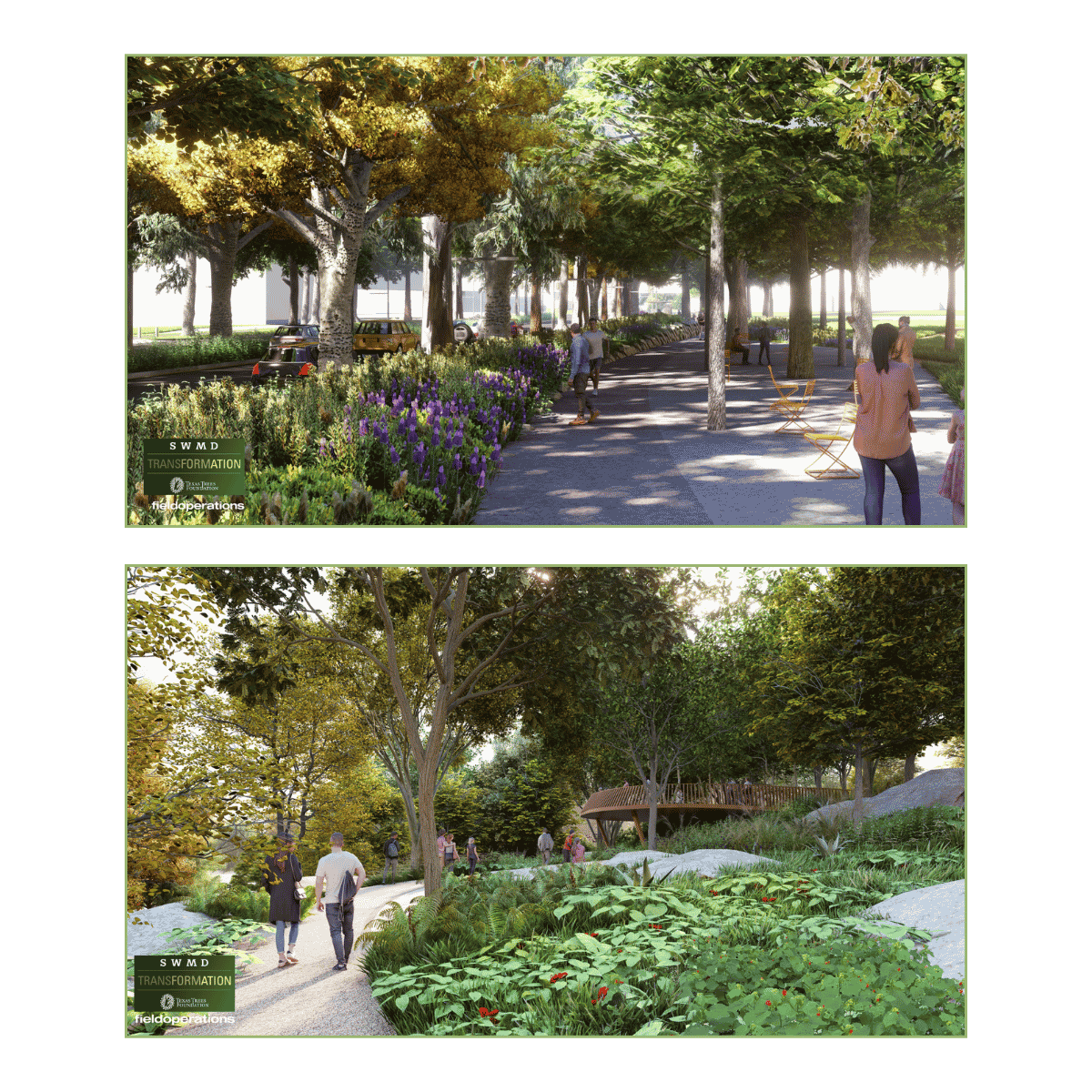
The intense realities of being in a Medical District, whether you’re a provider, patient, student, or caregiver, will not have changed, but the environment that encompasses the four walls of the buildings will have.
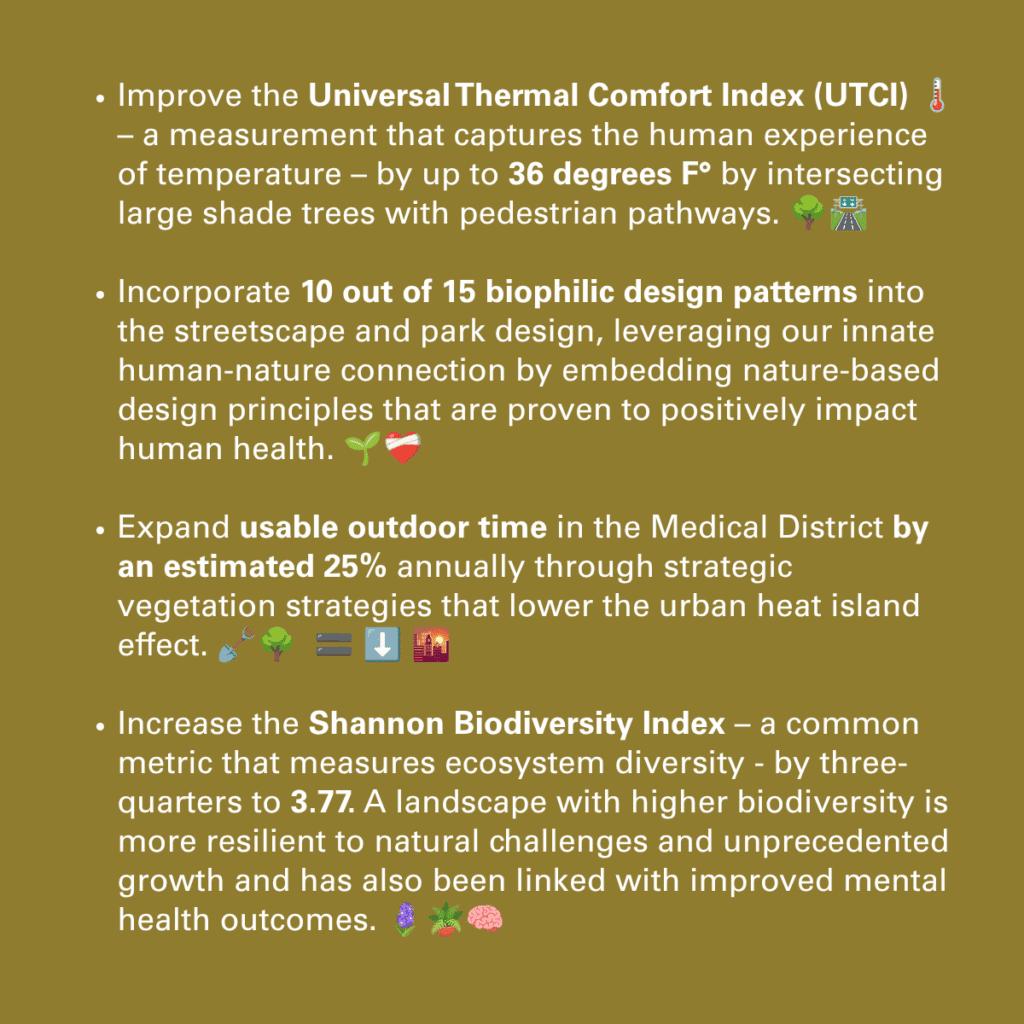
Our data-driven design strategies are projected to create the following impact:
The next portion of our program was our panel, featuring insights from two esteemed project leaders, Janette Monear, President & CEO, Texas Trees Foundation, and David Biegler, Chairman of the Board, Southwestern Medical District, and moderated by Heather Stevens, SWMD Capital Campaign Advisor. Janette and David's mutual tenacity, trust, vision, and ability to rally others together have helped steward the project to where it is today:
-
Established the foundation for the transformation, completing 30% design drawings for Phase I (Green Spine streetscape) and Phase II (Green Park).
-
Garnered significant public and philanthropic support, with $68M secured toward the project goal at the time of writing.
-
Actively progressing through the design development stage for Phase I.
-
Convened over 20 collaborators to accomplish this massive transformation.
Janette and David represent a key aspect of the SWMD Transformation that has ensured its success: strong public-private partnerships. Throughout our panel, they shared key reflections gleaned from their years of collective leadership:
1) The cycle of communication and information sharing with project stakeholders and collaborators is always ongoing. We are constantly giving output and receiving input. This scale of transformation must be deeply collaborative every step of the way. From vision through design to implementation, the Texas Trees Foundation and its consultants, our public agencies, the institutions of the Medical District, and more, are collectively shaping this project through regular meetings, workshops, written project updates, and more. Each collaborator offers unique perspectives, resources, and skills that strengthen the mission of the project. As the popular wisdom goes, “the whole is greater than the sum of its parts.”
This scale of transformation must be deeply collaborative every step of the way.
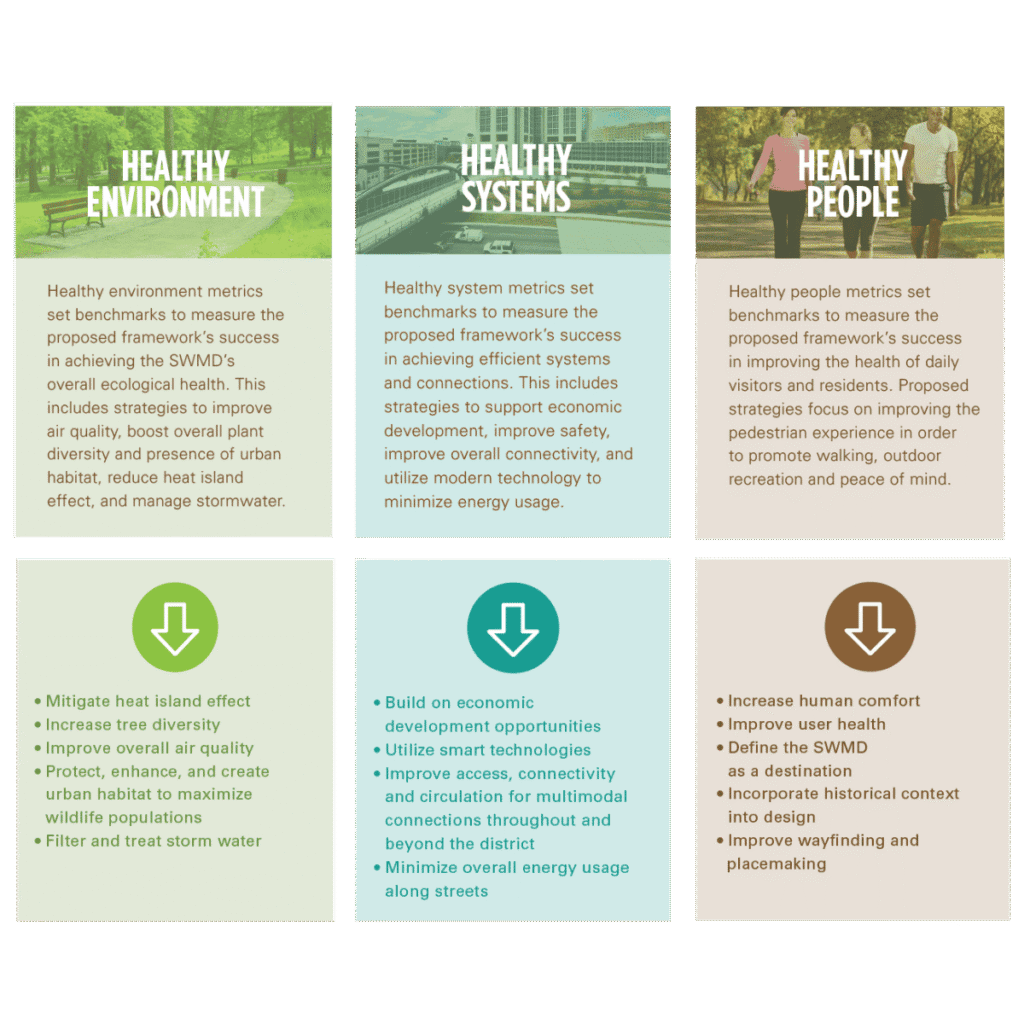
2) To gain project champions and advance the project forward, include the public, mobilizing everyone around a shared vision and belief while also appealing to the different priorities and strengths of each party involved. Our healthy people, places, and systems approach recognizes that healthy people are inseparable from the environments and systems that connect them. The implementation strategies and projected impact across these functions leverage various collaborators’ skills and strengths, and the comprehensive vision for the Medical District to function as a flourishing ecosystem is a mission that everyone can get behind.
For example, the Medical District institutions and our public agency partners are equipped with information such as ambulatory routes and traffic volumes, and can communicate wayfinding needs, to ensure we meet our goal of EMS accessibility (Healthy Systems). Our landscape design team can design resilient spaces that leverage local, native vegetation and materials, and sustainable design solutions, such as green stormwater infrastructure (Healthy Environments), while our biophilic design team can advise on how to design our site layout, features, materials, and amenities for physiological, cognitive, and mental health benefits (Healthy People).
3) Work backwards to go forward. From the beginning, Texas Trees Foundation project leaders secured a commitment from the Southwestern Medical District Board for ongoing Operations and Maintenance of the revitalized streetscape and new 8-acre Green Park. We are shaping a public space that is uniquely tailored to the neighborhood it is intended to serve: data-driven design is projected to measurably improve environmental conditions and, in turn, health outcomes, amplifying the District’s mission of health, healing, and innovation. Conversations during community engagement also revealed that the design and amenities should be more passive and tranquil in nature, acting as a natural oasis for the community more so than a vibrant attraction.
We must be similarly thoughtful regarding long-term operations and maintenance, so that we can protect the vision of this investment and ensure it is an asset to the Medical District for decades to come. A comprehensive O&M plan preserves intent – ensuring the park and streetscape remain activated, safe, and enjoyable, and that vegetation, site furnishings, and other pedestrian amenities are routinely cared for. The Southwestern Medical District’s enduring commitment to care for the Green Park and Green Spine reflects not only a direct investment in these physical spaces, but also in the broader health, well-being, and daily experience of its patients, employees, neighbors and the City of Dallas.
We must be similarly thoughtful regarding long-term operations and maintenance, so that we can protect the vision of this investment and ensure it is an asset to the Medical District for decades to come.
4) When asked what success looked like for the two leaders, distinct themes emerged. Harry Hines Blvd. is seen as the backbone anchoring the Medical District. After securing Harry Hines's transformation from a transportation corridor into a health corridor, the true success would be catalyzing similar investments throughout the District's broader 1,000 acres. That momentum is already happening. The Southwestern Medical District updated master plan features recommendations to organize the district around a series of mixed-use hubs that are further connected by networks of walkable open and green spaces. The Green Spine and the new Green Park are depicted as the lynchpin for this next era of pedestrian and nature-oriented investments.
The Green Spine and the new Green Park are depicted as the lynchpin for this next era of pedestrian and nature-oriented investments.
Both leaders reflected on how this project is all about pushing the envelope on best practices for designing our urban environments. With that in mind, what if every streetscape within the City of Dallas, whether it be long-established thoroughfares at our city's core, or streets that service the newest activity hubs that North Texans gravitate to, followed design principles that were driven to maximize positive human health and environmental outcomes? Now that would be truly unprecedented success.
More simply, both Janette and David stressed that it all boils down to making people feel as good as you possibly can about being in a Medical District, and how public-private partnerships work together to make ambitious goals reality.
It all boils down to making people feel as good as you possibly can about being in a Medical District
A big thank you to Jeff Kitner, Ken Malcolmson, and the entire North Dallas Chamber of Commerce staff and membership for hosting this conversation and for the great work you do to champion business initiatives in our community, making Dallas a better place to live, work, and play.
It's always a joy to be in the same room with esteemed Dallas leaders to share the vision and progress of the SWMD Transformation and imagine new ways to collaborate and amplify each other's work.
Let's move forward in transforming Dallas together!
Curious about all of the good stuff going on in the Medical District?
-
Check out our website, and particularly, this blog post for a deep dive into the SWMD Transformation.
-
Visit swmeddistrict.org to read the District's 2024 updated Master Plan.
-
Read the Dallas Business Journal’s coverage of the program: '$225 million Medical District makeover could deliver much-needed win for Dallas.'