
When was the last time you truly fell in love with nature? Cherished the fleeting, soft golden hues and dappled light of golden hour? Paused to admire birdsong or plant life rustling in the breeze? Stood in awe of towering tree canopies or blooming wildflower meadows?
This is exactly what we invited our community to do during “Growing Love: A Biophilic Conversation on Health, Nature and the Future of Dallas.”
The early signs of spring at the Dallas Arboretum were a fitting setting for us to be immersed in the SWMD Transformation Project – a public-private partnership to transform a major urban center, transportation corridor, and heat island into a green haven designed for health and healing. It was also an ideal environment to hear from expert panelists in the fields of biophilic design, landscape architecture, and regenerative architecture.
We were delighted to convene an audience of professionals in the architecture, planning, design, and healthcare fields, government officials, philanthropic partners, and faculty and students from local universities for this important discussion. Together, we covered how design professionals are already employing biophilic strategies across all kinds of environments, and how the field is evolving and expanding to return more people and natural environments to harmony with one another.
Our conversation offered both tangible examples of how humans are drawn to nature and the growing body of science that illuminates this intricate relationship. Couldn’t join us, or want to re-live this inspiring discussion? Continue reading to learn more.
Biophilia: Humans' Affection for Nature
The term ‘biophilia’ first dates back over sixty years ago to social psychologist, Eric Fromm’s, The Heart of Man (1964), but it was biologist, Edward Wilson, who popularized the term in his book, Biophilia (1984), when he outlined biophilia as “the innate and instinctive affinity humans have for other living organisms and nature”, experienced both as an emotional connection and the sense of well-being derived from time in nature (E.O. Wilson Biodiversity Foundation).
That same year, researcher, Robert Ulrich published the landmark study, ‘View through a window may influence recovery from surgery’, where he found that patients recovering from gallbladder surgery who had views of trees from their hospital bed recovered faster, had fewer complaints for their medical staff and required fewer, less potent pain medications, compared with patients who viewed a brick wall.
The research has evolved to show even more compelling evidence of how biophilia benefits us today: Nature can assert its calming effect in as little as 40 seconds. Exposure times of 60 minutes can foster creativity, stabilize heart rate and blood pressure, and lower cortisol levels, our primary stress hormone.
When compared to urban or office noise levels, nature sounds, like chirping birds or moving water, were found to decrease cognitive fatigue, replenish energy and motivation, and expedite physiological and psychological restoration by up to 37%.
Frumkin et al.’s 2017 study provides a comprehensive overview of the health benefits associated with nature contact, including reduced depression, better sleep, better life satisfaction, reduced aggression, and improved cognitive and motor development in children (For the complete scope of benefits, see Fig. 1, Pg. 2).
Hopefully, you’re already experiencing the benefits of nature in your own rhythms and routines - whether you enjoy a walk to wind down at the end of a long day, seek some sunshine or a cool breeze on your lunch break, or visit the local trail or park on the weekends. Now, we hope you’re equipped with the language and science to explain the vast health benefits of nature. But what can we do to seek out more biophilia in the places we frequent, or, if we’re in the driver’s seat of designing our future environments, what can we do to carve out more room for biophilic experiences?
Creating Healthy and Healing Environments through Biophilic Design
As the research continues to deepen our understanding of how nature supports human health and well-being, our ability to embed biophilic principles into the built environment has evolved in parallel.
We were lucky to be joined by three incredible panelists for Growing Love who are shifting the paradigm in the fields of architecture and design. They have dedicated their careers to leveraging the healing power of nature in design, creating spaces from gardens and courtyards to hospitals and schools that energize, inspire, and restore their users using strategic nature-based and biophilic design strategies.

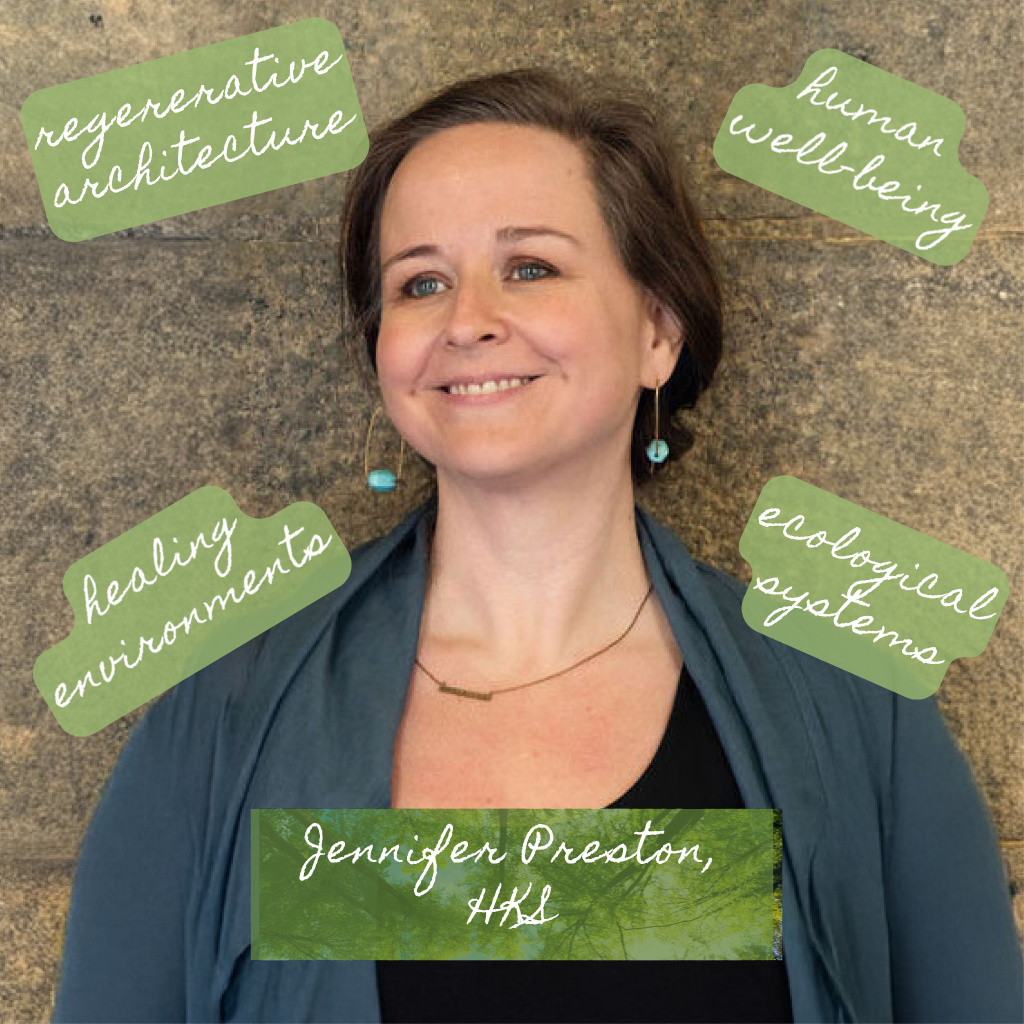
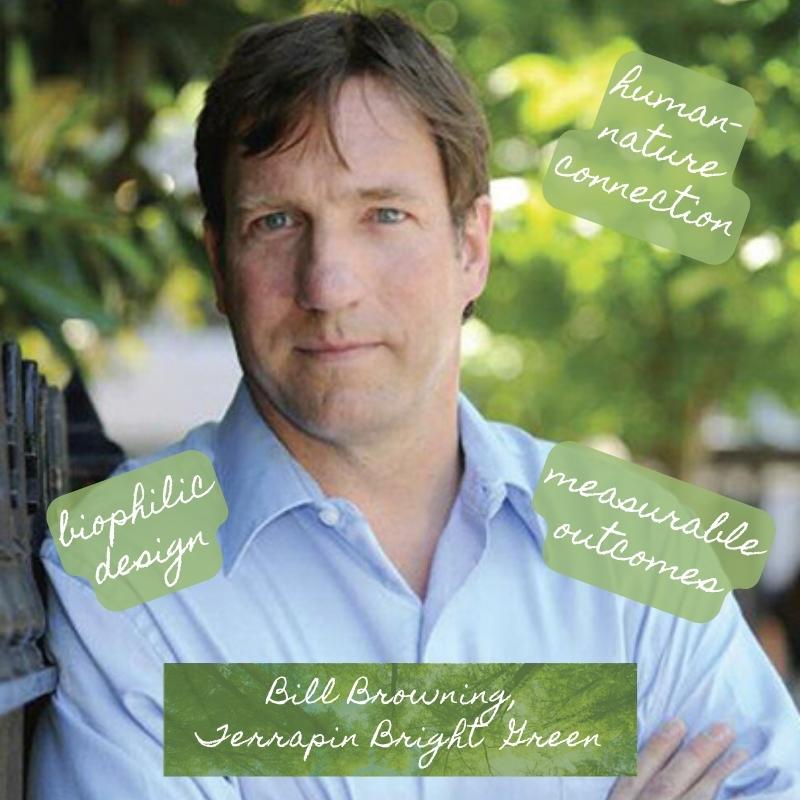
Biophilic design offers a powerful, applied solution to our innate desire for connection with nature by seamlessly integrating natural elements and processes into the built environment. It plays a critical role in creating healthy places for people to live and work – reducing stress and enhancing overall health and wellbeing.

Much of our conversation at Growing Love centered around the cutting-edge 14+ Patterns of Biophilic Design report produced by Terrapin Bright Green. The report was originally released in 2014, but a special anniversary edition was published in 2024, with the expansion including an additional pattern, Awe, due to the increased body of research that supports awe’s ability to transform perspectives and inspire positive attitudes and behaviors.
Terrapin’s 15 Biophilic Design patterns provide a strategic framework to guide and elevate the design process – mapping fifteen distinct forms of biophilic design, each associated with a unique range of health benefits related to physiological stress reduction, cognitive functionality and performance, and mental health and well-being. These techniques can be deployed intentionally to create desired impacts at desired locations.
Terrapin Bright Green has been a key collaborator in the SWMD Transformation Project, providing biophilic design consulting services concurrent with design milestones, ensuring that the relationship between human health and nature remains central to design decisions throughout the entire project.
We know that the Southwestern Medical District is an incredible center for health, healing, and recovery. It’s where millions go each year to seek care and thousands pursue callings in the medical field. For one provider to urge during community engagement, “This area is desperate for nature. It is all buildings and traffic. As someone who works in the medical field, it can be very stressful and having trees around me would be very calming” should reveal to us that something is missing: The public realm should be serving as part of the care team.
People’s journeys in the Medical District begin long before they enter the waiting room or are seen by a provider. They start at the edge of the district with signage or landscaping that signals arrival, at the bench on the sidewalk where you pause to rest or reflect, or along the ‘last-mile’ journey from where you’ve parked or arrived via transit, to the doors of the building.
Our panelist, Jennifer, offered us an empowering reminder when she asserted that, “We are the cartographers of our future.” Biophilic Design patterns equip us to rewrite the story, creating an outdoor environment that augments the District’s mission of delivering renowned health, healing, research, and innovation.



Picture the Green Park’s Hilltop Lawns, which demonstrate Thermal & Airflow Variability. Designed with a variety of micro-environments, such as the refuge of large shade trees and the freedom of the open air, this pattern introduces subtle shifts in air temperature and wind flow, creating a dynamic, invigorating, and comfortable space that provides users with flexibility and a sense of control. On the contrary, research cited by Terrapin found that environments lacking sensory stimulation can cause boredom or passivity. And, as a bonus, we found that design strategies such as this can create spaces that feel more comfortable across a variety of seasons or weather conditions, increasing usable outside time by up to 25% annually.
The Garden Rooms in the Green Park integrate Non-Visual Connection with Nature, leveraging fragrance, texture, and bloom calendars, to create a dynamic, sensory-rich environment. Garden Rooms foster awareness of seasonality and cycles of life, creating a deep, lasting bond with the natural environment, and cultivating feelings of nostalgia, enlightenment, and anticipation. This pattern reduces stress, lowers blood pressure, and increases cognitive performance and creativity.
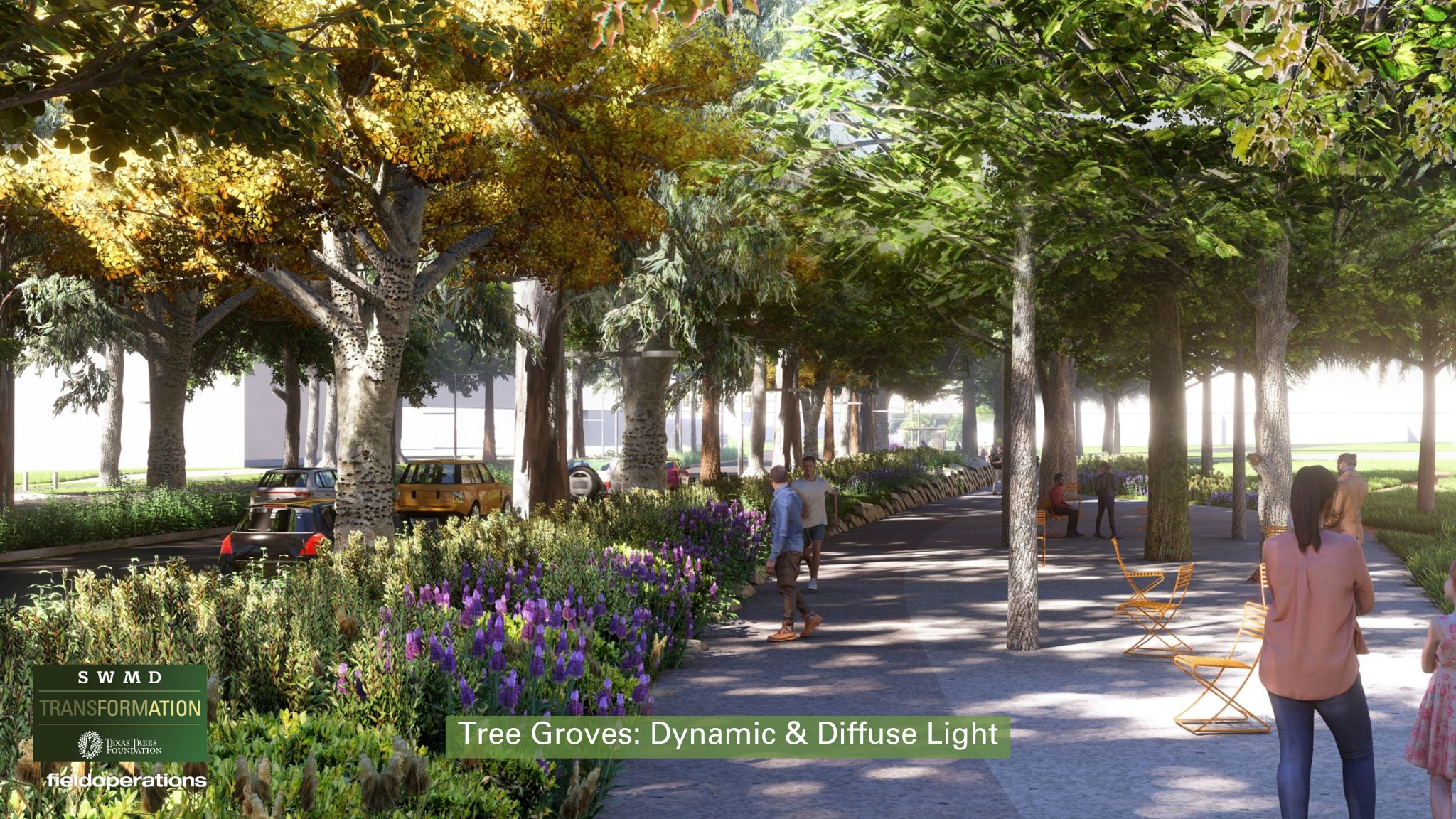
The Tree Groves will be a defining characteristic along the Green Spine and incorporate the pattern of Dynamic & Diffuse Light. Dense tree canopy will create a dappled interplay of sun and shade as sunshine filters through the branches, creating a fascinating fractal pattern effect that has been shown to reduce stress responses by up to 60%. With no one tree grove area exactly alike, this pattern will convey the passage of time and movement throughout the Green Spine, evoking a sense of intrigue, inducing positive mood, and amplifying behavioral performance and attitude.
Even material choices matter. Materials that reflect native ecology or geology reinforce biophilic cues and strengthen our connection to the environment. Design features in the Green Spine and Green Park, such as rock walls that buffer vegetation from pedestrian pathways, or wood-clad furniture and seating areas, create a distinct and authentic sense of place. The Material Connection with Nature pattern inspires exploration, encourages tactile engagement, and enhances visual connections with the surrounding landscape.
Our team has embraced the opportunity to reimagine the Medical District’s outdoor environment not as a medical challenge, but as a design challenge, where interdisciplinary experts can come together to make a powerful case study for how our physical environment plays a major role in our health and well-being. To date, we celebrate that we have incorporated 10 of the 15 biophilic patterns in our design!
Biophilia: Rediscovering the Intuitively Obvious
When we get to speak about biophilia in front of engaged audiences like those at Growing Love, we are often met with affirming nods or murmurs of agreement, and we get to be privy to people’s ‘Aha!’ moments, where the emotional reaction coupled with the science to support biophilia clicks in our brains.
At the event, Bill recounted an early roadblock in his biophilia-dedicated career, where a philanthropic foundation shot down a request for funding to support biophilia research, retorting, “Why would I fund work that is essentially ‘rediscovering the intuitively obvious’?” Bill has kept good spirits in the decades since this rejection, as he’s serendipitously adopted this definition to describe biophilia today.
In a City like Dallas, where over 1/3 of the surface area is covered with impervious surfaces – think roads, buildings, & parking lots – [And in our Medical District – 86%!], average tree canopy is 29% [And in our Medical District – 5%!], extreme urban heat is an ever present reality and is intensifying, and frequent mental distress affects up to 20% of Dallas County adults, we could argue that our urban environments and lifestyles have evolved in such a way that need a clear reminder of what was once intuitively obvious now than ever. As Jennifer shared at the event, “we may have gotten a little too used to the impervious surface we’ve created”.
Research suggests that people’s desire to return to a more natural harmony with nature is stronger than ever. Richard Louv represents another groundbreaking research perspective, having coined the term nature-deficit disorder in 2005 to describe “the human costs of alienation from nature”, affecting physical and emotional health, learning and development, and more. In ‘The Nature Principle’, Louv argues that the more we drift from nature, the more we need nature.
The consensus we’ve gathered from community engagement suggests that the Medical District community desires a place to be in nature, where they can take their lunch break outdoors, hold a walking meeting, or where biking or walking to work from a nearby residence is feasible. With research demonstrating that nature views or access to green space at work can increase worker satisfaction, reduce staff stress, and improve quality of life, biophilia is a sound investment.
"During my precious 30-minute break, I need a breather. I leave for a bit for a cup of coffee, and I just look at the sky. I try to interact with the small amount of nature that is here".
-SWMD Health Practicioner
"I would love to be able to have more meetings in outdoor spaces. It is good to get staff or clients outside of the walls to brainstorm a new idea. Immediately, a change of pace changes the mood and flow of a meeting."
-SWMD Health Practicioner
"When surveyed about their current and future preferred modes of travel, driving is the only mode projected to decline—dropping from 86% to 52%—while demand for walking and biking rises significantly, with 72% and 35% of respondents expressing a desire to use these modes in the future."
-SWMD Health Practicioner
Medical students and practitioners have a lot of options to weigh when considering where to begin or build their careers – what if access to green space were one of them? Jennifer described nature’s unique ability to serve as a “shared ground”, a powerful concept in a Medical District shaped by a wide spectrum of daily experiences. Patients and families navigate health-related hardships; providers bear the profound responsibility of delivering care; and students and researchers dedicate themselves to advancing the future of medicine. In this context, green space becomes much more than an amenity, but a welcoming retreat and a place of refuge for all.
Responding directly to these diverse and deeply human needs, Justin and the Field Operations team bring a people-first design approach rooted in both empathy and performance. As Justin shared, their work spans “from the scale of a city to the scale of a seat”, ensuring that every design decision is intentional and strategic. This approach is critical in addressing challenges like urban heat, which can intensify health vulnerabilities and disproportionately affect both the very young and the elderly. Evidence-based design strategies – such as placing trees where they’re most needed – can improve thermal comfort by up to 36°F. At the same time, sensory-rich planting strategies – recall the Tree Groves and Garden Rooms described earlier – will create dynamic, engaging environments that offer something new with each visit.
The Future of Biophilia is Bright!
We can be encouraged by the progress that has been made in the broader field: In research literature, papers with the term “biophilic design” or “biophilia” have increased by an average of 30 annual peer-reviewed articles at the start of the century to roughly 1050 annual publications in 2024. In application, biophilic design has been refined and adopted by professionals across the fields of landscape architecture, architecture, neuroscience, and more.
When asked about what success looks like for them, our panelists’ responses similarly signaled a positive trajectory. Jennifer shared optimistically about biophilic design becoming more commonplace in the healthcare design field, applauding the growing trend of hospitals explicitly including “biophilia” and “biophilic design’ in their Requests for Proposals or Qualifications. Bill highlighted the increased availability of low-cost technology to measure neurological response to green environments – both pre- and post- intervention, making for more thoughtful biophilic design interventions with transferable applications. Justin offered a simple yet powerful perspective: fostering an appreciation for nature through the environments he designs – rooted in his own lifelong love of plants and nature, nurtured from a young age – is what he considers true success.
The Southwestern Medical District Transformation Project represents both an enormous task and an incredible opportunity to integrate biophilic design on a large-scale and in a high-impact area that already gives so much to our City at the intersection of health, healing, research, and innovation. In the Southwestern Medical District, nature will soon become an integral part of the care team, and biophilic design will showcase its power in creating an environment where people and nature thrive.
Just as our panelists prompted us, we invite you to seek out more biophilia in your day-to-day life. At your local park, the neighborhood coffee shop, or the shopping center where you run errands, see if you can spot any of the biophilic design patterns in action. We hope that what you’ll encounter will leave you with a deeper appreciation of nature’s intricacies and an intimate understanding of how nature makes us happier, healthier, stronger, and so much more. Designers, planners, and architects – harness the power of biophilia in the spaces you are designing and your own spheres of influence, so that the positive impacts of biophilia can reach communities and cities at scale
For anyone interested in shaping the future of the Southwestern Medical District, connect with our team, explore our website, or engage with us online.
Further Reading
- The Heart of Man
- Biophilia
- E.O. Wilson Biodiversity Foundation
- ‘View through a window may influence recovery from surgery’
- Lee et. al 2015
- Determan et. al 2019
- Jahncke et. al 2011
- Alvarsson et. al 2010
- Frumkin et. al 2017
- Terrapin Bright Green - 14+ Patterns of Biophilic Design
- UC Irvine: School of Social Ecology
- Office of Energy Efficiency and Renewable Energy
- Rethinking the Future
- The Conversation
- Texas Trees Foundation – Biophilic Design Infographic
- Texas Trees Foundation - State of the Dallas Urban Forest Report
- The Southwestern Medical District 2024 Master Plan
- Texas Health 2025 Community Needs Assessment
- Last Child in the Woods
- The Nature Principle
- Sadler et. al 2008
- Dravigne et. al 2008
- Christofi et. al 2025