
Why the Future of Healthcare Must be Built Into Our Cities
We tend to think of health as something that happens inside hospital walls, under bright lights, in exam rooms, guided by clinicians and cutting-edge technology. But the truth is far more fundamental and far more urgent. Health begins long before a patient ever sees a doctor.
It begins on the sidewalk.
In the air we breathe.
In the shade, or lack of it, on a 100-degree Texas afternoon.
In whether a nurse, a patient, or a family member can safely cross the street, access transit, or simply walk along the sidewalk without fear.
As Janette Monear, President & CEO of the Texas Trees Foundation, often says: “If we are serious about improving health outcomes, we must start by improving the environments people move through every single day. The places between and around buildings matter just as much as what happens inside them.”
“If we are serious about improving health outcomes, we must start by improving the environments people move through every single day. The places between and around buildings matter just as much as what happens inside them.”
- Janette Monear, President & CEO, Texas Trees Foundation
The Data is Clear: Place Shapes Health
Research estimates that clinical care accounts for only about 20% of health outcomes. The remaining 80% is driven by social, environmental, and behavioral factors, what we now call the social determinants of health.
- People living in walkable neighborhoods have up to 40% lower risk of obesity and chronic disease.
- Access to green space is linked to lower stress, improved mental health, and reduced cardiovascular risk
- Poor air quality contributes to 1 in 5 deaths globally
- Urban heat islands, common in dense urban hubs such as our Southwestern Medical District, can feel up to 20°F hotter than surrounding areas, increasing heat-related illness and mortality
And yet, we continue to design many of our most critical neighborhoods around cars, not people.

The Paradox of Medical Districts
Nowhere is this contradiction more visible than in major medical districts. These are places dedicated to healing, yet often surrounded by: high-speed roadways, limited pedestrian infrastructure, minimal tree canopy, and fragmented transit access.
They are environments that unintentionally undermine the very outcomes they are meant to improve. For the healthcare workforce, providers, nurses, and support staff, this means daily stress, unsafe commutes, and limited access to restorative space. For patients and families, it can mean confusion, anxiety, and physical barriers at the very moment they are most vulnerable.
What if we treated infrastructure as a form of preventive medicine? What if every street, every shaded pathway, every transit connection and every neighborhood was designed with health outcomes in mind? This is not theoretical, it is measurable, actionable, and increasingly necessary.

These investments are so much more than amenities, they are health interventions and necessary.
A New Model for Healthcare Infrastructure
At the Texas Trees Foundation, we believe the future of healthcare extends beyond buildings, it lives in the spaces between them.
The Southwestern Medical District Transformation Project is built on a simple but powerful idea: If we want healthier outcomes, we must build healthier environments.
Janette Monear puts it plainly: “This project is about redefining what healthcare infrastructure means. It’s not just hospitals and research facilities, it’s the streets, the shade, the safety, and the accessibility that surround them.”
This means rethinking infrastructure as: a tool for public health, a driver of economic resilience, and a foundation for equity and access.
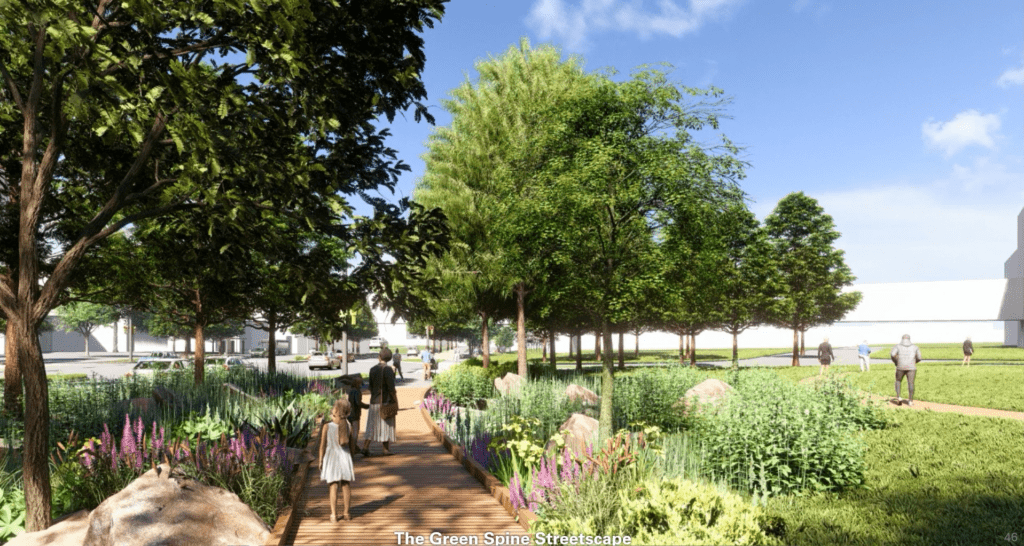
Fortunately, Medical District leaders recognize the importance of investing in the outdoor environment as an invaluable tool for amplifying the District's mission of health and healing. David Biegler, Chairman of the Board, Southwestern Medical District, shares, "We are excited about the new streetscape amenities and park expected along the Harry Hines corridor. The medical complex’s three major hospitals have a long history of commitment to health and healing. Having a surrounding green space that is expected to improve physical, social, and mental health for patients, visitors, and staff in the district is a welcome addition.”
This unique model which blends health and space aligns transportation systems, and landscape and urban design strategies with the needs of the people who rely on these spaces every day.
And it means recognizing that the journey to healing doesn’t begin at the hospital door, it begins the moment someone leaves their home.
“This project is about redefining what healthcare infrastructure means. It's not just hospitals and research facilities, it's the streets, the shade, the safety, and the accessibility that surround them."
- Janette Monear, President & CEO, Texas Trees Foundation
The Opportunity Ahead

We are at a pivotal moment. Cities across the country are grappling with rising healthcare costs, climate pressures, and growing inequities in access to care. At the same time, we have more data, more tools, and more proven strategies than ever before. The question is no longer whether the built environment impacts health, the question is whether we are willing to design for it. Because when we do, the return is profound: healthier communities, stronger economies, and more resilient cities.
And most importantly, better outcomes for the people we serve.
Healthcare leaders, policymakers, urban planners, and philanthropists all have a role to play. If we continue to invest only in what happens inside hospital walls, we will remain in reactionary mode. Both are vital and deserve equal support to truly transform human health: both within the walls and when they step outside of those walls. When we invest in the environments that shape daily life, we have the opportunity to prevent, to improve, and to transform our cities into healthier, cleaner, greener, and cooler environments.
Health does not start in a hospital. It starts in the world we create around it.
“We are excited about the new streetscape amenities and park expected along the Harry Hines corridor. The medical complex’s three major hospitals have a long history of commitment to health and healing. Having a surrounding green space that is expected to improve physical, social, and mental health for patients, visitors, and staff in the district is a welcome addition.”
- David Biegler, Chairman of the Board, Southwestern Medical District
This blog was authored by Heather Stevens, SWMD Transformation Project Campaign Advisor, and President & CEO, Rise360.